A paradigm shift in resuscitation training


The challenge
3X difference in survival
In the US, around 300,000 in-hospital cardiac arrests occur annually. Only 1 in 4 patients survive1, with rates ranging from under 10% to nearly 40% across hospitals.
Standardizing CPR quality across hospitals could help save approximately 50,000 additional lives annually in the US.
THE OPPORTUNITY
Competency-based education
Research in the early 2010s showed that CPR skills often deteriorate within three to six months, making two-year refresher intervals inadequate.
Instead, allowing healthcare professionals to refresh skills in short, quarterly sessions at a skill testing session at their workplace was shown to be effective in counteracting skill decay and greatly improved skill performance over time.
This model also reduced training costs and provided greater convenience for both the hospital and healthcare providers by eliminating the need for off-site courses and offering flexible scheduling. But most importantly, quality of care improved. At one of the early adopters of this methodology - Texas Health Presbyterian Hospital in Dallas - survival doubled in the first year.
the program
Low-dose, high-frequency training
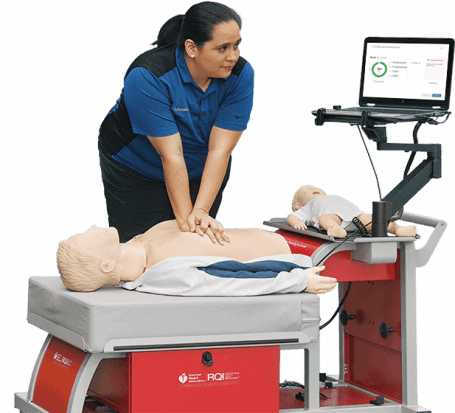
The significant lifesaving potential motivated the American Heart Association® (AHA) and Laerdal to form a partnership in 2018; RQI Partners, to help accelerate Resuscitation Quality Improvement® (RQI®) program adoption by hospitals and health systems.
The RQI program follows a low-dose, high-frequency model offering quarterly CPR skills refreshers. The program provides mastery learning via deliberate practice, implemented through quality improvement sessions that measure and verify competence. When asked if they learn best by practicing CPR in smaller and more frequent practice sessions versus practicing CPR once every two years, 76% of learners surveyed agree high-frequency learning is better.*
The cognitive part of RQI uses the AHA-Laerdal HeartCode® program’s e-learning component, which breaks down the curriculum into bite-size learning activities each quarter.
In place of the two-year “course completion card.” the program issues an “e-Credential,” which verifies the learner is competent in resuscitation skills.
*Based on 2.45M responses to the RQI Provider annual questionnaire, launched between April 2019 and September 2025.

Building upon our decades-long alliance and collaborative suite of products, the American Heart Association and Laerdal Medical introduced Resuscitation Quality Improvement in 2015. This innovative digital program is setting a new global standard in CPR training and can help save many more lives from cardiac arrest.
- Nancy Brown, CEO, The American Heart Association
THE IMPACT
Going to scale in US and growing internationally
A study directly comparing instructor-led training with the RQI program showed that providers recently trained in BLS with an instructor were unable to meet the AHA’s guidelines for correct compressions and ventilation when measured objectively at an RQI Simulation Station.
Prior to RQI, only 53% of learners were able to perform high-quality adult compressions at the Simulation Station. After one session with real-time feedback, learners improved their adult compression scores by 19%, and adult ventilation scores grew by 40%.**
Our digital resuscitation programs, including RQI, are now used by more than 4 million healthcare professionals in more than 3,000 healthcare organizations in more than 20 countries. In the U.S., healthcare professionals enrolled in RQI have practiced over 765 million individual ventilations and 3.6 billion individual compressions at RQI Simulation Stations... and counting.
This year marked the 10-year anniversary of the RQI program’s introduction to the healthcare market and collaborating with leading organizations such as UT Southwestern Medical Center, Texas Health Resources and University of Rochester Medicine to create a culture of resuscitation excellence. It is estimated that more than 20,000 lives have been saved since the program’s debut.
**Data based on performance of 2.3M learners enrolled in RQI Provider from July 2018 to September 2025.

Driving the mission
RQI for newborn resuscitation
We continue to expand the RQI program footprint through continued collaboration and strategic relationships with global organizations that share our lifesaving mission, including the American Academy of Pediatrics (AAP) and the National League for Nursing.
In 2021, the AAP, Laerdal and the American Heart Association launched RQI for NRP®. Rooted in the AAP’s Neonatal Resuscitation Program® and the RQI program, this innovative quality improvement initiative helps providers master and maintain critical skills, including positive pressure ventilation, in a convenient, on-site learning environment.
Nearly 120 institutions of higher education are using RQI or HeartCode® Complete, with 75 being nursing schools. It is estimated that more than 150,000 students graduate from nursing programs at U.S. colleges and universities annually. Upon graduation, these students will be empowered with competency-based resuscitation education and make a significant impact on the health outcomes of their patients and the healthcare systems and communities they serve.

RQI for nurse education
In 2021, Laerdal's and its longstanding strategic partner, the National League for Nursing, collaborated to bring the RQI program to US nursing schools.
Nearly 40 nursing programs at US colleges and universities have adopted RQI, becoming the first higher education institutions to introduce true competency-based education for resuscitation. It is estimated that more than 150,000 students graduate from nursing programs at U.S. colleges and universities annually. Upon graduation, these students will make a significant impact on the health outcomes of their patients and the healthcare systems and communities they serve.

A long-standing partnership
Laerdal and the American Heart Association have worked together for more than 50 years.
In 1974, Laerdal supported the publication and distribution of the AHA’s first “Standards and Guidelines for Cardiopulmonary Resuscitation and Emergency Cardiac Care.” In 1997, a vital alliance was formed between the two organizations leading to the development of the HeartCode e-learning program and the Mini Anne kit for CPR training in schools and the community. In 2015, they co-developed and introduced the Resuscitation Quality Improvement program to US hospitals. Based on the “Low-Dose, High-Frequency” (LDHF) principle, the RQI program standardizes resuscitation training - requiring learners to participate in more frequent training focusing on continuous improvement of competence and confidence.
